
This page is part of an mirror of © FOTW Flags Of The World website
This website is devoted to the science of vexillology (the study of flags).
All illustrations presented on this website serve exclusively to provide information in the context of vexillology.
The authors and hosts of this site explicitly distance themselfes from any symbols of unconstitutional organizations that may be depicted here.
Last modified: 2026-06-13 by martin karner
Keywords: vexillological terms |
Links: FOTW homepage |
search |
disclaimer and copyright |
write us |
mirrors
On this page:
![[Palau]](../images/v/vx-pw.gif)
![[example]](../images/v/vx-ua_r1.gif)
![[disc]](../images/v/vx-tl}updc.gif)
National Flag of Palau;
Roundel, Ukraine;
Flag of the Christian-Democrat Party of East Timor
![[voided disk]](../images/v/vx-za-ec-gt.gif)
![[voided disk]](../images/v/vx-no)06-05.gif)
![[voided disk]](../images/v/vx-no-06-05.gif)
Flag of Grahamstown, South Africa;
Arms and Flag of Ringerike, Norway
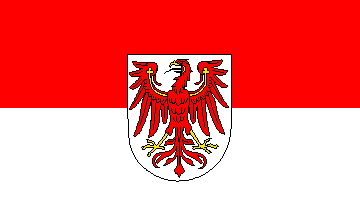
Flag of Brandenburg, Germany;
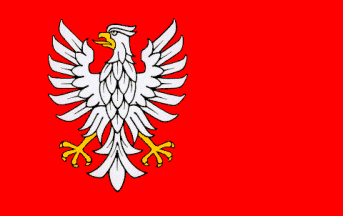
Flag of Mazowieckie, Poland;
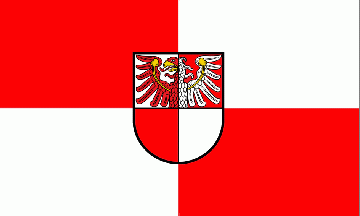
Flag of Barnim, Germany
![[distaff]](../images/v/vx-pt-mmvsg.gif)
![[distaff]](../images/v/vx-pt-stnil).gif)
![[distaff]](../images/v/vx-pt-pcrbc-bi.gif)
Flag of Seixo de Gatões, Portugal;
Arms of Ilha, Portugal;
Flag of Bico e Cristelo, Portugal
![[distinction jack]](../images/v/vx-gb~priv.gif)
Distinction/Privateer Jack 1694–1801, England/UK
Notes![[distinction of colour]](../images/v/vx-gb~rdadm.gif)
![[distinction of colour]](../images/v/vx-gb~whadm.gif)
![[distinction of colour]](../images/v/vx-gb~bladm.gif)
Command Flags of Flag Officers of the Red,
White and Blue 1625–1702
a) This system was formally introduced in 1625, amended in 1653, extended in
1805 (the rank of Admiral of the Red was introduced following Trafalgar) and abolished in 1864.
b) Until the early 18th century however, these were not part of the naval rank structure, but were
(rather) positions conferred by royal appointment to cover a specified campaign (although once an admiral
always an admiral).
c) In 1653 the order of seniority was changed from red, blue and white to red, white then blue.
![[distinction pendant]](../images/v/vx-myt~1std.gif)
![[distinction pendant]](../images/v/vx-myt~3rdd.gif)
Distinction Pennants 1 and 3 in Marryat's Code of Signals for the Merchant Service
1817–1857
![[distinguishing flags]](../images/v/vx-ar^min.gif)
![[distinguishing flags]](../images/v/vx-us^ddsc.gif)
![[distinguishing flags]](../images/v/vx-ua_nsdcu.gif)
Minister of Defence, Argentina;
Secretary for Defense US;
National Security and Defense Council, Ukraine
Please note, that although these terms are sometimes considered interchangeable, the Editors have drawn a general distinction between the command flags used by senior naval officers, the rank flags employed by officers from the other armed services, the distinguishing flags of civilians and with personal flags.
![[distinguishing jack]](../images/v/vx-hr_pres.gif)
![[distinguishing jack]](../images/v/vx-gb~conaf.gif)
![[distinguishing jack]](../images/v/vx-es^pri71.gif)
Presidential Standard, Croatia;
Consular Officer Afloat, UK;
Royal Standard, Spain
Notes
a) In Germany and Austria, Government (as well as civilian) vessels often fly the flag of the relevant
state/province as a distinguishing jack.
b) In some commonwealth countries the appropriate departmental flag is specified as a jack for
government vessels.
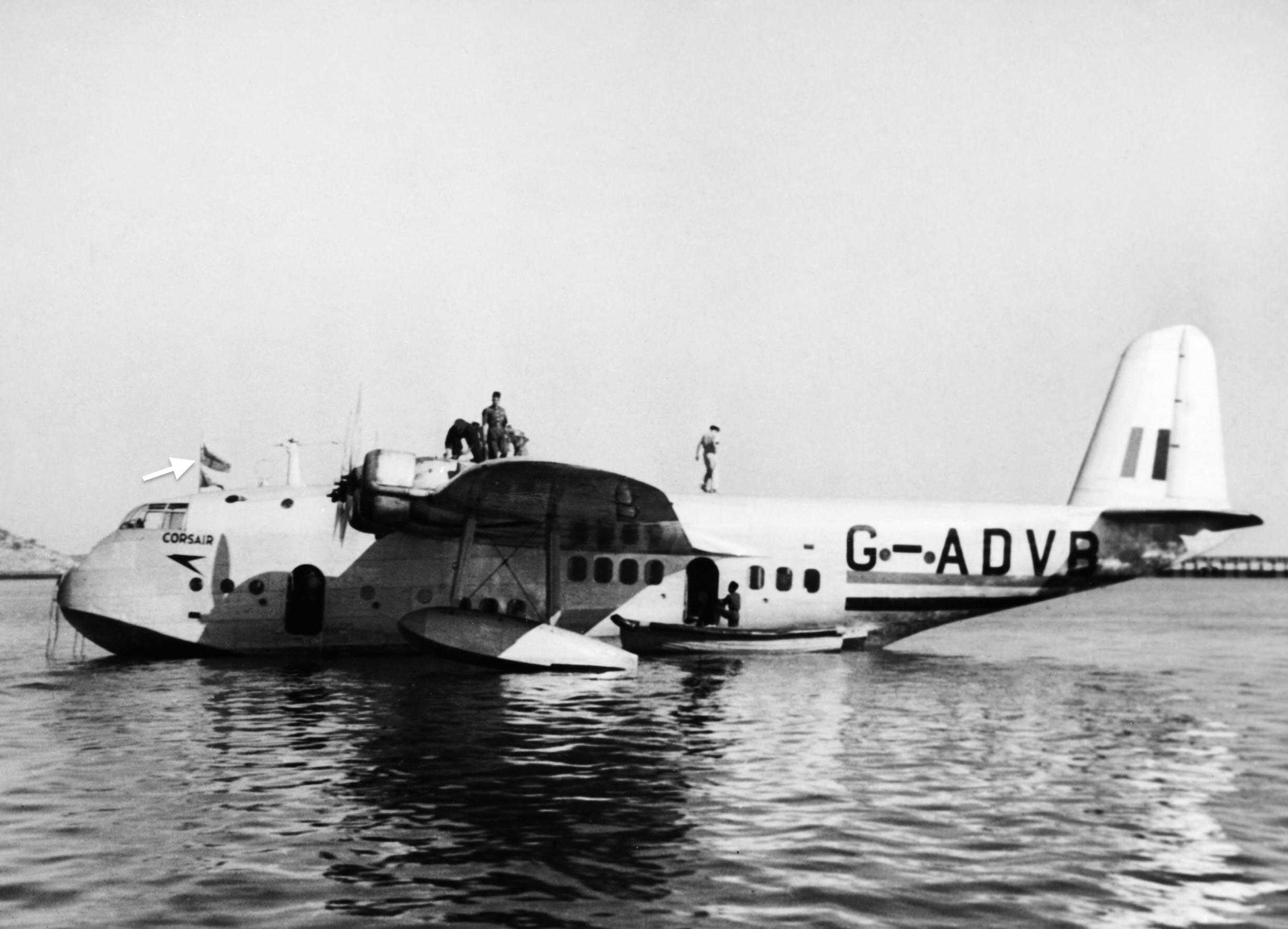
c) In UK usage now obsolete, the British Civil Air Ensign was flown as a jack by those tenders who
serviced the flying boats of Imperial Airways (1924–1939).
![[distinguishing jack]](../images/v/vx-gb_ca.gif)
Short Empire Flying Boat 1941–43, UK (Wikimedia);
Civil Air Ensign, UK
![[distinguishing flags]](../images/v/vxt-d1064.gif)
A Stealth Warship of the Royal Norwegian Navy Flying the Distinguishing Marks of Ensign, Jack
and Masthead Pennant
Please note that this distinguishing mark is invariably the ship's ensign, to lesser extent the masthead pennant and in some cases also the jack (see also ensign jack masthead pennant 1)) and suit of flags).
![[distinguishing plate]](../images/v/vxt-d1033.gif)
Distinguishing/Rank Plate of a Vice Admiral RN, UK
![[diver below flags]](../images/v/vx-ics~alph.gif)
![[diver below flags]](../images/v/vx-qs-dive.gif)
Signal Flag Alpha;
Unofficial Warning Flag
Please note however, that while often referred to as unofficial, use of 2) is required by law in most US states, and by law or regulation in some other countries.
![[diverging stripes example]](../images/v/vx-nl-fl-zw.gif)
Flag of Zeewolde, Netherlands
![[divided example]](../images/v/vx-au-ab.gif)
![[divided example]](../images/v/vx-ug.gif)
![[divided example]](../images/v/vx-be~civ.gif)
Aboriginal Flag, Australia;
National Flag, Uganda;
Civil Flag and Ensign, Belgium
![[divided example]](../images/v/vx-tg.gif)
National Flag of Togo in the golden mean/divine ratio
Please note that the above phrase does not refer to the dividing of a shield or flag into two or
more straight-sided sections as illustrated below – see impaled
quartered.![[division example]](../images/v/vx-nl-ge-gb.gif)
![[division example]](../images/v/vx-ch-be324.gif)
![[division example]](../images/v/vx-bh.gif)
Flag of Groesbeek, The Netherlands;
Flag of Seftigen, Switzerland;
National Flag of Bahrain
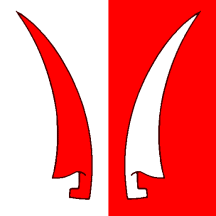
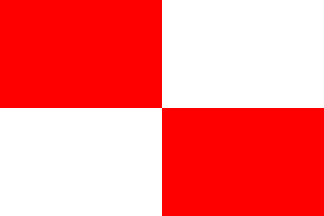
Flag of Sugnens, Switzerland;
House Flag of Freitas Martins, Portugal
Introduction | Table of Contents | Index of Terms | Previous Page | Next Page
Advertisement from our sponsor:
Bei Fahnenversand.de erhalten Sie eine Vielzahl an hochwertigen Flaggen, Pins und Aufnähern, zum Beispiel:


