This page is part of an mirror of © FOTW Flags Of The World website
This website is devoted to the science of vexillology (the study of flags).
All illustrations presented on this website serve exclusively to provide information in the context of vexillology.
The authors and hosts of this site explicitly distance themselfes from any symbols of unconstitutional organizations that may be depicted here.
Last modified: 2026-07-18 by martin karner
Keywords: vexillological terms |
Links: FOTW homepage |
search |
disclaimer and copyright |
write us |
mirrors
On this page:
Please note with regard to 2) that the word is occasionally used to indicate a colour within, or of,
a charge.![[background]](../images/v/vx-hr-sb-ng.gif)
![[background]](../images/v/vx-hr)sb-ng.gif)
Flag and Arms of Nova Gradiška, Croatia
![[badge illustration]](../images/v/vxt-d2249.gif)
![[badge illustration]](../images/v/vx-lk)1875.gif)
![[badge illustration]](../images/v/vx-ca_rnc.gif)
Camp Flag of the Training and Development Branch, Canada;
Badge of British Ceylon 1825–1948;
Flag of the Royal Newfoundland Constabulary, Canada
Please note with regard to 1) however, that with a large degree of heraldic justification, some sources propose the charge to be an integral part of a flag’s design and generally not used separately, whereas, in general a badge may. It is, therefore, suggested that the entry ‘badge in heraldry’ below and a suitable glossary or heraldic dictionary be consulted.
![[badge illustration]](../images/v/vx-plantag.gif)
![[badge illustration]](../images/v/vx-tudorrose.gif)
![[badge illustration]](../images/v/vx-prinwales.gif)
Badge of the Royal House of Plantagenet 1154–1399, England; Badge of the Royal House
of Tudor 1486–1603, England; Badge of HRH Prince William of Wales, UK (all: aroyalheraldry.weebly.com).
Notes
a) In Scottish heraldry, the crest on the wreath may be used as a badge.
b) It is suggested that the badge fell out of general
use in personal English heraldry during the reign of Queen Elizabeth I (1533–1603).
![[badge banner]](../images/v/vxt-d667.gif)
Badge Banner of the Royal House of Tudor, England c1530
![[badge banner]](../images/v/vxt-d668.gif)
Badge Pennon of the Earls of Warwick, England c1450
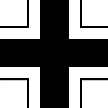
Please note that this cross (in essence a simplified form of the Iron Cross) was originally introduced as a German aircraft marking in April 1918, and has no connection with the Balkans.
Please note that this cross (a simplified form of the Iron Cross as referenced above and illustrated
below) was originally introduced as a German aircraft marking in April 1918, and has no connection
with the Balkans. 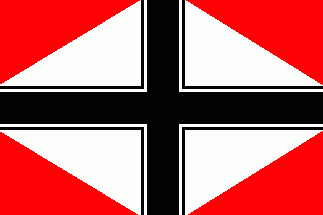
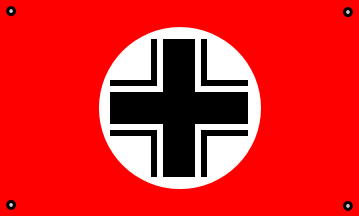
Flag of the German Sailing Union 1912–1934;
Example;
Aircraft Recognition Drape of the Army ca. 1944, Germany
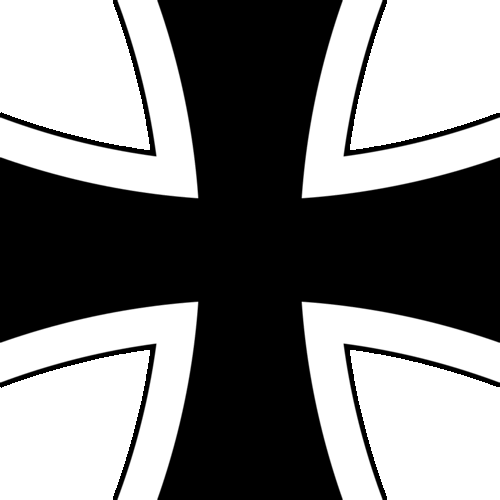
Aircraft Recognition mark c1917 and in current use, Germany (Wikipedia)
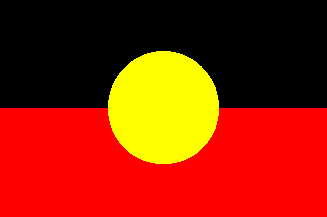
Aboriginal Flag, Australia;
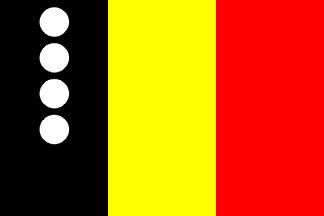
Lt Admiral's Rank Flag c1858, Belgium;
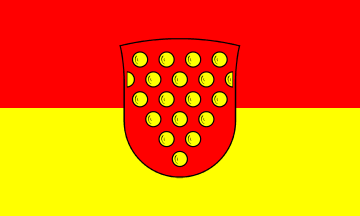
Flag of Grafschaft Bentheim, Germany
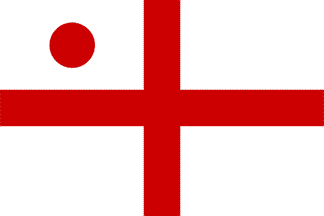
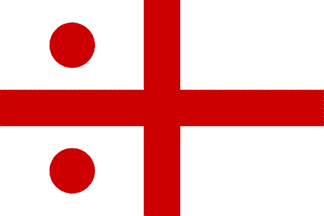
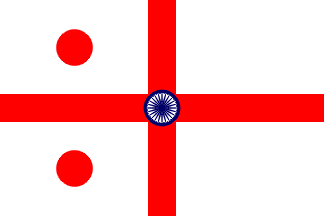
Flags of a Vice Admiral and Rear Admiral
Royal Navy, United Kingdom; Flag of a
Rear Admiral 1950–2001, India.
Please note that in British usage the present design dates from regulations of 1898. These regulations reduced the width of the red cross, increased the size of the balls and moved their position on the flag of a rear-admiral (as illustrated below).
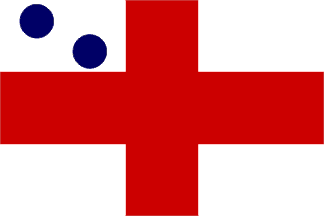
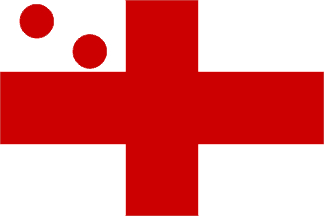
Boat Flag of a Rear Admiral of the White ca. 1702–1864;
Boat Flag and then Command Flag of a Rear-Admiral 1864–1898, UK
![[Bauceant]](../images/v/vx-rel-baux.gif)
A conjectural image of the Balzaus/Bauceant
![[example of stripes]](../images/v/vx-cf.gif)
National Flag of the Central African Republic
![[bandera de ceremonia]](../images/v/vx-ar.gif)
National Flag of Argentina
![[bandera de guerra]](../images/v/vx-pe^.gif)
![[bandera de guerra]](../images/v/vx-pe)emb.gif)
Bandera de Guerra/War Flag, and
National Arms of Peru
![[bandera de guerra]](../images/v/vx-es^1810b.gif)
Banderas Coronelas/King’s Colour of the Barcelona Regiment of
Light Infantry 1810, Spain
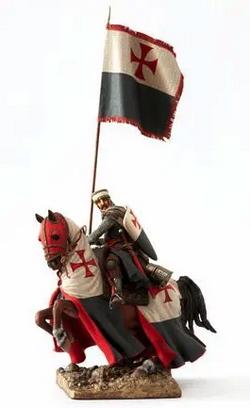
![[banderarius]](../images/v/vx-banderarius.jpg)
(figurenschnapp.de)
Please note – not to be confused with bannerole.
![[banderole]](../images/v/vx-ch-be105.gif)
Flag of Sonvilier, Switzerland
Please note, that banderia is a plural form of bandum, and that it has been suggested 1) may have been Latinized from a Celtic original.
![[banera]](../images/v/vxt-d1088.gif)
![[banera]](../images/v/vx-hu_anjou.gif)
Banera/Lance Pennon, English c1360; Banera/Banner from Hungary 14th c.
![[banner of arms]](../images/v/vx-cz-sy-gr.gif)
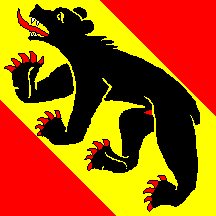
![[banner of arms]](../images/v/vx-cz-br-hb.gif)
Flag of Gruna, Czechia;
Flag of Bern, Switzerland;
of Horní Benešov, Czechia
![[badge illustration]](../images/v/vx-gb-1399.gif)
![[badge illustration]](../images/v/vx-gb-royun.gif)
English Royal Standards: 1399–1413,
1603–1688
Notes
a) A banner of council first appeared in English sources during the first
half of the 14th century (dates of between 1337 and 1351 are suggested), and had ceased to be recorded
by the 18th century.
b) Use of a flag with
this meaning was by no means limited to England’s navy, with instructions for
a combined Mediterranean galley fleet of 1366 being just one example.
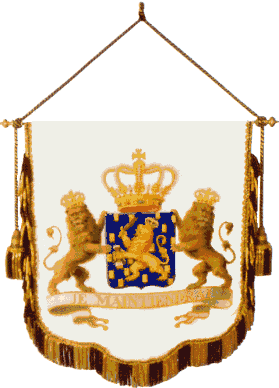
Rijksvaandel of the Netherlands
![[Russian banner of victory]](../images/v/vx-su^vctry.gif)
![[Russian banner of victory]](../images/v/vxt-d501a.gif)
Banner Raised Over The Reichstag, Berlin 1945; Banner According To
Current Practice (CS)
Notes
a) With regard to 1), the Cyrillic wording on the flag –
150 стр. Ордена Кутузова II ст.
идрицк. див. 79 С.К. 3У.А.IБ.Ф
– means “150th Rifle Idrickaâ
Division (Awarded Order of Kutusov, II Degree), 79th Joint Corps, 3rd Shock
Army, 1st Byelorussian Front”
b) From 2005 any such flags officially
displayed at the Victory Day Celebrations will not show the hammer and sickle.
Special insert page: BANNER
Introduction | Table of Contents | Index of Terms | Previous Page | Next Page
Advertisement from our sponsor:
Bei Fahnenversand.de erhalten Sie eine Vielzahl an hochwertigen Flaggen, Pins und Aufnähern, zum Beispiel: