
This page is part of an mirror of © FOTW Flags Of The World website
This website is devoted to the science of vexillology (the study of flags).
All illustrations presented on this website serve exclusively to provide information in the context of vexillology.
The authors and hosts of this site explicitly distance themselfes from any symbols of unconstitutional organizations that may be depicted here.
Last modified: 2026-05-23 by martin karner
Keywords: vexillological terms |
Links: FOTW homepage |
search |
disclaimer and copyright |
write us |
mirrors
On this page:


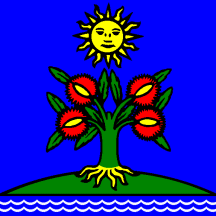
Flag of Oberhof, Switzerland;
Flag of Vestre Slidre, Norway;
Flag of Massagno, Switzerland
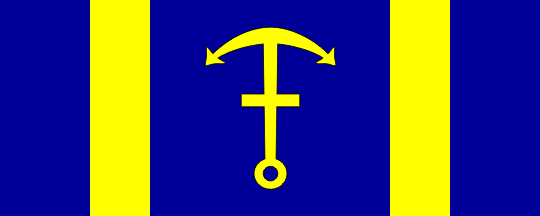
Flag of Cirkulane, Slovenia

Flag of Birżebbuġa, Malta
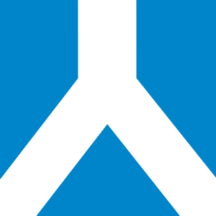
Flag of Kråkerøy, Norway
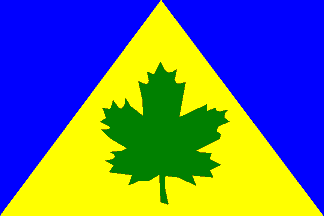
Flag of Šárovcova Lhota, Czechia
![[German Naval Jack]](../images/v/vx-de~1903j.gif)
![[Iron Cross]](../images/v/vx-ironcross1813.gif)
![[iron cross]](../images/v/vx-de1919wm.gif)
Naval Jack 1903–1919, Germany;
Iron Cross 1813, Prussia (Wikipedia);
Flag of the War Minister 1919–1921, Germany
Notes
a) The above term should only be used when the cross
pattée being described is black, carries a white or silver border and/or is of Germanic origin.
b) Although based upon a military decoration this cross was ultimately derived from the symbol of the
Medieval Teutonic Order as referenced above.
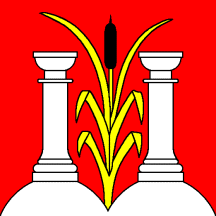
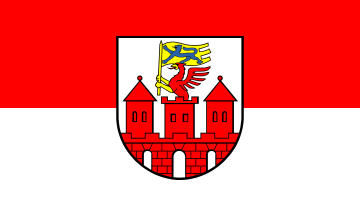
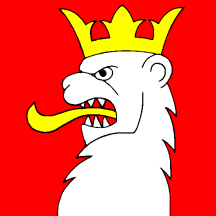
Flag of Sâles, Switzerland;
Flag of Recknitz-Trebeltal, Germany;
Flag of Augst, Switzerland
Please note that in modern heraldry the term for a charge or figure emerging from the side of a shield, banner of arms or a flag is naissant – see naissant 1).
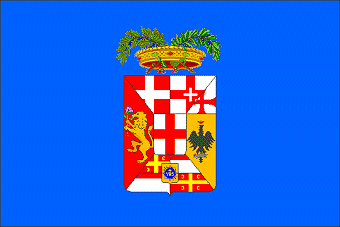
Flag of Alessandria, Italy
.gif)
The Arms of Messina, Italy (Wikimedia)
Please note that several of the terms giving shields a national identity, as well as those describing a specific type, are still in the process of standardization, and that no consistent approach has thus far been identified.
Introduction | Table of Contents | Index of Terms | Previous Page | Next Page
Advertisement from our sponsor:
Bei Fahnenversand.de erhalten Sie eine Vielzahl an hochwertigen Flaggen, Pins und Aufnähern, zum Beispiel:



![[Gay triangle flag]](../images/v/vx-qq-p3n.gif)
![[St. Patrick's Cross]](../images/v/vx-ie-stpat.gif)
