
This page is part of an mirror of © FOTW Flags Of The World website
This website is devoted to the science of vexillology (the study of flags).
All illustrations presented on this website serve exclusively to provide information in the context of vexillology.
The authors and hosts of this site explicitly distance themselfes from any symbols of unconstitutional organizations that may be depicted here.
Last modified: 2025-06-19 by antónio martins
Keywords: (no keywords) |
Links: FOTW homepage |
search |
disclaimer and copyright |
write us |
mirrors
|
|
|
Note: Bold face language links indicate “main” "flag" word.
The large tree rooted at late Latin
"banderia".
António Martins, 15 Aug 2007
A very fertile ancestor word: Most descendants come through Spanish "bandera" and/or Portuguese "bandeira", but some (namely old European words such as Gaelic "baner" and almost all Italic and Gallic dialects) seem to derive directly from Late Latin "banderium" (plural: "banderia"). This in turn seems to come from Persian, perhaps via Byzantine Greek "mpandon", but I could not confirm this.
At any rate, I know a Portuguese word that seems related: "pano", meaning "cloth"; it seems to share a common etym and yet didn’t come along with Latin "banderia". On the other hand, there’s Latin "pendere", "to hang" (as in "pending" = "“hanging” in wait") — from which derive several "flag" words, such as English "pennant" and Spanish "pendón".
Would "ban(d)-" stem be cognate with the root of so many words akin to *"fan-", found in most Germanic languages?
António Martins, 12 Sep 2007
A common etymology for these words is "cloth", as in French
"drapeau" and its numerous offspring of words meaning
"flag" in several languages. As far as I know, it does not
mean "cloth" in French (any more), but cognates "trapo"
in Portuguese and "тряпка"
in Russian both mean "rag".
António Martins, 12 Sep 2007
"Vaan" is related to
"Fahne" in German
and "vane" in English:
All of them eventually come from
Germanic
either "gundfano" ("gund-fano" = "war-cloth",
which one would expect to be related to "*gonfanon" /
"*gonfalon" somehow),
or directly from "fano",
"cloth". In Old-Frisian this was "fona", hence the modern
Sealtersk "Foone"
and Frasch "foone".
Peter Hans van den Muijzenberg, 24 Oct 2007
Would the "ban(d)-" stem be cognate with the root of
so many words akin to *"fan-", found in most Germanic languages?
António Martins, 12 Sep 2007
Maybe Tongan "fuka"
is based on "flag" (via English), just
like Ndyuka "faaka"?
António Martins, 06 Sep 2010
I tried to find Mayan pictograms for these words with unsatisfactory results: There seems to be no known pictogram reading "pan" (though it is probably composable), and I found multiple results for "lakam".
In this Virginia University document, two pictograms are listed and glossed, and illustrated in two pages of the same site:
| "0213.00","lakam" "0213.01","lakam" |
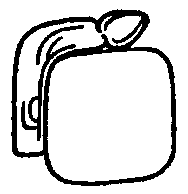
213: lakam BM 213a: lakam BM |
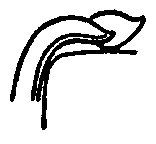
213b: lakam BM |
| "0767.00","lakam" "0767.01","lakam" |
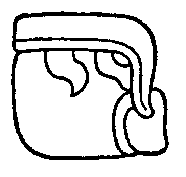
767: lakam BM 767a: lakam BM |
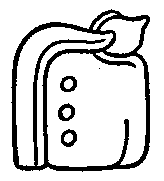
767b: lakam BM |
| source | source | source |
|---|
António Martins, 02 Nov 2007
The word for "flag" in Finnish
("lippu") and Estonian
("lipp") (and others from the same
etym, I presume) is derived from an onomatopoeia (Source: English
Wiktionnary entry for
"lipp" and
"lippu"),
i.e., a word that sounds like what it stands for. I wonder what kind
of wind and rigging would cause a flag to go lip-lip, though, and if other
languages have anything like this.
António Martins, 23 Mar 2016
"Steg/stijeg"
is parallel to "standard" — the flag that
denotes the "standing/standpoint" of its owner.
Željko Heimer, 16 Aug 2007
Also "zastava" has that meaning:
at least in Russian
"стоять"
means "to stand (up)" ("za" being a dative
preffix / preposition). Similar etymologies seem to be common for
many words meaning "flag", reinforced, of course,
by each other.
António Martins, 12 Sep 2007
"Steg/stijeg" is parallel to
"standard" —
the flag that denotes the "standing/standpoint"
of its owner.
Željko Heimer, 16 Aug 2007
Also "zastava" has that meaning:
at least in Russian
"стоять"
means "to stand (up)" ("za" being a dative
preffix / preposition). Similar etymologies seem to be common for
many words meaning "flag", reinforced, of course,
by each other.
António Martins, 12 Sep 2007
Would the semantic differentiation found in
Central Bikol be also the case of other
Pilippine languages where the Spanish etym
"bandera" / "bandila"
exists along local etym words of the type "*wa-wa-"?
António Martins, 21 Jul 2009
"Steg/stijeg"
is parallel to "standard" —
the flag that denotes the "standing/standpoint"
of its owner.
Željko Heimer, 16 Aug 2007
Also "zastava" has that meaning:
at least in Russian "стоять"
means "to stand (up)" ("za" being a dative
preffix / preposition). Similar etymologies seem to be common for
many words meaning "flag", reinforced, of course,
by each other.
António Martins, 12 Sep 2007
Anything below this line was not added by the editor of this page.
Advertisement from our sponsor:
Bei Fahnenversand.de erhalten Sie eine Vielzahl an hochwertigen Flaggen, Pins und Aufnähern, zum Beispiel:


