This page is part of an mirror of © FOTW Flags Of The World website
This website is devoted to the science of vexillology (the study of flags).
All illustrations presented on this website serve exclusively to provide information in the context of vexillology.
The authors and hosts of this site explicitly distance themselfes from any symbols of unconstitutional organizations that may be depicted here.
Last modified: 2021-10-16 by  klaus-michael schneider
Keywords: eichstaett | castle(silver) | oak | acorns(6) | basement |
Links: FOTW homepage |
search |
disclaimer and copyright |
write us |
mirrors
![[Eichstätt city flag rw]](../images/d/de-ei-ei.gif) 2:3  image by M. Schmöger, 16 Oct 2009 image by M. Schmöger, 16 Oct 2009
|
![[Eichstätt city flag wr w/ script]](../images/d/de-ei-ei2.gif) 2:3 image by M. Schmöger, modified by Klaus-Michael Schneider, 17 Sep 2021
|
It is a red-white horizontal bicolour with centred arms (see left image above) or a white-red horizontal bicolour with centred arms and a white serifed inscription "EICHSTÄTT" under the shield (see right image above).
Source: this online catalogue
M. Schmöger, 16 Oct 2009
![[Eichstätt city banner]](../images/d/de-ei-ei_.gif) 63:20 image by M. Schmöger, 16 Oct 2009
63:20 image by M. Schmöger, 16 Oct 2009
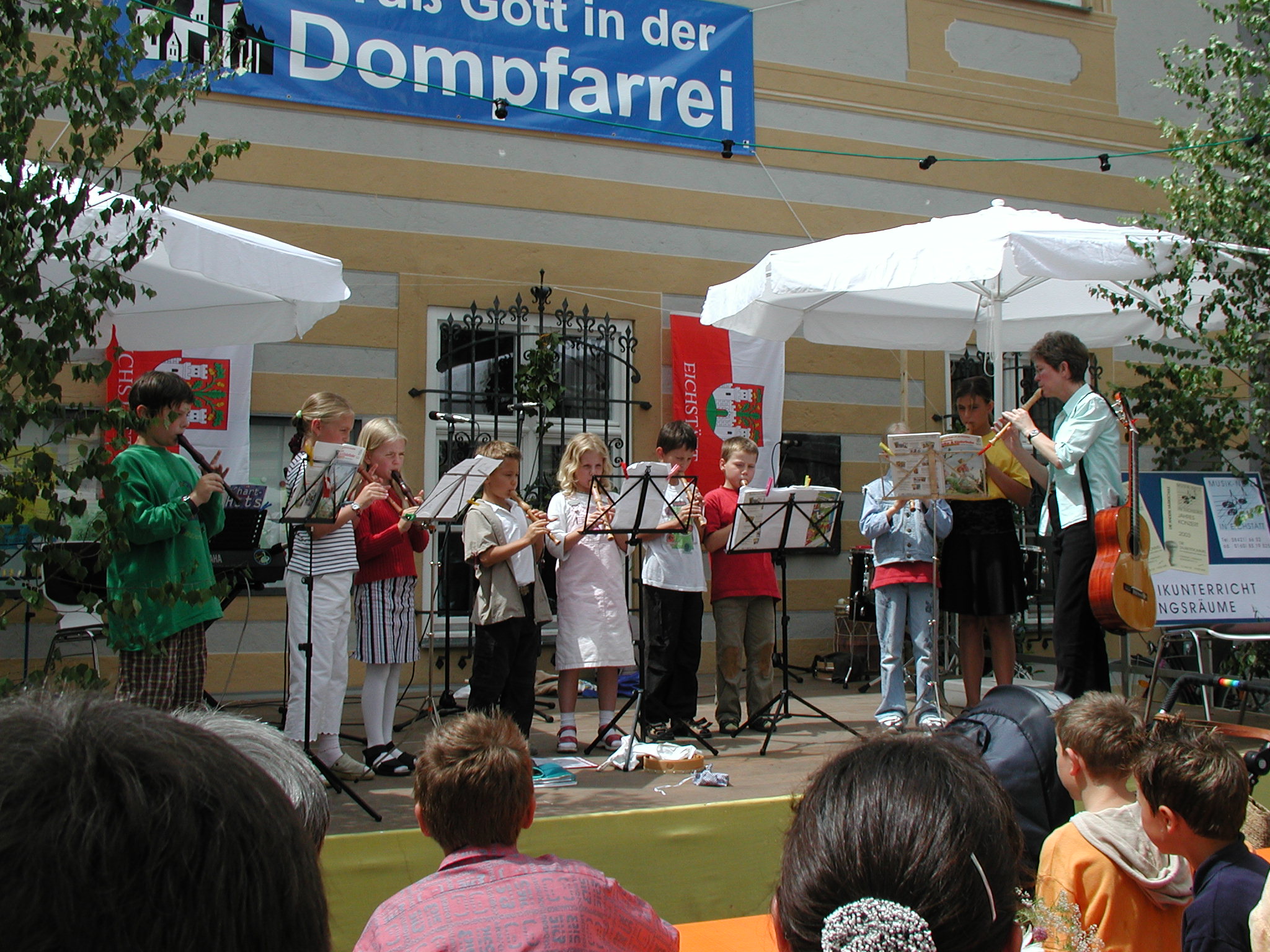
It is a vertical red-white bicolour with arms shifted to top.
Source: this online catalogue this photo
Klaus-Michael Schneider, 17 Sep 2021
![[Eichstätt city banner after photo]](../images/d/de-ei-ei2_.gif) 2:7 image by M. Schmöger, 16 Oct 2009
2:7 image by M. Schmöger, 16 Oct 2009
It is a vertical white-red vertical bicolour with arms shifted to top.
Source: http://kommunalflaggen.de/cgi-bin/db.pl?eintrag:09176123:
Klaus-Michael Schneider, 17 Sep 2021
![[Eichstätt city CoA]](../images/d/de-ei-ei).gif) image by Jarig Bakker, 24 Aug 2008
image by Jarig Bakker, 24 Aug 2008
Gules a city gate Argent flanked by two turrets, issuing from base vert, surmounting an oak tree Vert with acorns or.
Meaning:
A seal of the city was already mentioned in 1256 as "Eihstat". The oldest retained seal is found on a charter dated 1304, which shows the depicted arms.
The settlement of Eichstätt was mentioned for the first time in 740 in connection with the foundation of a bishopric. In 908 Bishop Erchanbald acquired the right from King Ludwig the Child of markets, mint and customs, as well as the privilege to build a castle. It was named a city (Statt, Latin:civitas) on coins of Bishop Heribert (1022-1042), later on a charter of King Heinrich IV in 1080. The walls on the arms represent that elevation to a city. The name "Eichstätt" was understood as "Eichenstätte" (place of oaks), which was the reason, why an oak was placed on the arms, making it canting.
Source: sta65, p.45
Stefan Killermann, 23 Aug 2008
The arms are traditional and based on a seal from 1295.
Klaus-Michael Schneider, 17 Sep 2021
back to Eichstätt cities and municipalities click here
Advertisement from our sponsor:
Bei Fahnenversand.de erhalten Sie eine Vielzahl an hochwertigen Flaggen, Pins und Aufnähern, zum Beispiel: