
This page is part of an mirror of © FOTW Flags Of The World website
This website is devoted to the science of vexillology (the study of flags).
All illustrations presented on this website serve exclusively to provide information in the context of vexillology.
The authors and hosts of this site explicitly distance themselfes from any symbols of unconstitutional organizations that may be depicted here.
Last modified: 2022-10-01 by rob raeside
Keywords: artemivsk | donetsk | bakhmut |
Links: FOTW homepage |
search |
disclaimer and copyright |
write us |
mirrors
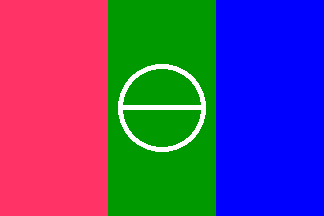 (2:3) image
by Antonio Martins, 12 September 1999
(2:3) image
by Antonio Martins, 12 September 1999
See also:
from the site of Ukrainian
Heraldry :
"On 7 August 1996 the session of City Council approved the
gonfalon: a rectangular canvas with a ratio of the parties 2:3.
The gonfalon consists of three vertical equal stripes - crimson,
green and dark blue - with the white chemical symbol of salt in
the centre. "
Phil Nelson, 7 July 1999
from the site of Ukrainian
Heraldry :
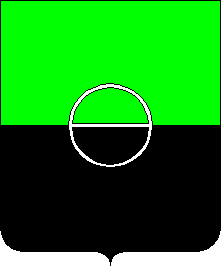
"The Coat of Arms of the Russian period was confirmed on 29
July 1811. In a per fess with vert and sable shield is the
picture of a chemical sign of salt - the reason for the
foundation of the town. On 27 March 1996, town council session
confirmed the Coat of Arms of 1811 as an official symbol."
Phil Nelson , 7 July 1999
from the site of Ukrainian
Heraldry :
"City in Doneck (Donets'k) Oblast. It is mentioned as a
Cossacks lodge Bakhmuts'ka in 1571. Since 1712 it is known under
the name of Bakhmut. The same year the extraction of salt began
in its neighborhood."
Phil Nelson , 7 July 1999
In 'Ukraine, A Historical Atlas' by P. R. Magocsi (1987):
Bakhmut was the center of 'Slavic Serbia', where Serbian and
other Balkan immigrants were settled (probably to work the
salt mines) c. 1750.
Jarig Bakker , 12 July 1999
Advertisement from our sponsor:
Bei Fahnenversand.de erhalten Sie eine Vielzahl an hochwertigen Flaggen, Pins und Aufnähern, zum Beispiel:


