This page is part of an mirror of © FOTW Flags Of The World website
This website is devoted to the science of vexillology (the study of flags).
All illustrations presented on this website serve exclusively to provide information in the context of vexillology.
The authors and hosts of this site explicitly distance themselfes from any symbols of unconstitutional organizations that may be depicted here.
Last modified: 2014-06-29 by klaus-michael schneider
Keywords: escutcheon | bezant | quinas: 5 (11 plates) | quina: 11 plates | christ | portugal ancien |
Links: FOTW homepage |
search |
disclaimer and copyright |
write us |
mirrors
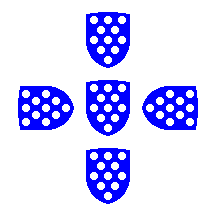
King Sancho I changed the design to five eschutcheons (small
shields) blue arranged in a cross (the ones in the sides pointing
to the center, the other three pointing downwards), each charged
with 11 silver circles. These five eschutcheons
(quinas) are said to represent
the five wounds of Christ (hands, feet and chest).
António Martins, 21 May 1997
This armourial bearings, called “Portugal
ancien” (argent, five eschuteons set in cross, the middle ones
pointing downwards and the side ones pointing inwards, each charged with
3+2+3+2+1 silver bezants) wre first used in 1185, with king D. Sancho I.
António Martins, 02 Oct 1998
Those bezants were heraldry marks of kingship, symbolizing silver coins (and the royal right to coinage), adopted in 1143, when Count Afonso Henriques was first acclaimed as (the first) King of Portugal. It was not exactly eleven, at the beguining, I suppose. That is the number usually seen on later documents, but until the number of bezants gets fixed at five in 1578 (much later!) it varies. Afonso III (1248-1279), for instants, used sometimes seven (1+2+1+2+1), and sometimes sixteen (4+3+4+3+2, as Duke of Bologna).
So, in the time of Afonso Henriques (1143-1185) it was just a blue cross semmy of bezants. Only a practical (or maybe aestethical or mystical-symbolic) reason could account for the positioning of those silver nails in five distinct areas. Later, when Afonso Henriques died, the old shield (which, out of battle proudness, was not repaired in those days) had lost all of the blue cross material (dyed leather), remainning only attached the parts covered with the nails. Hence the eschuteons…
António Martins, 08 Oct 1998
Anything below this line was not added by the editor of this page.
Advertisement from our sponsor:
Bei Fahnenversand.de erhalten Sie eine Vielzahl an hochwertigen Flaggen, Pins und Aufnähern, zum Beispiel: