
This page is part of an mirror of © FOTW Flags Of The World website
This website is devoted to the science of vexillology (the study of flags).
All illustrations presented on this website serve exclusively to provide information in the context of vexillology.
The authors and hosts of this site explicitly distance themselfes from any symbols of unconstitutional organizations that may be depicted here.
Last modified: 2014-06-29 by klaus-michael schneider
Keywords: quinas: 5 (16 plates) | quinas: 5 (7 plates) | quina: 7 plates | quina: 16 plates | castille bordure | castle (yellow) | royal standard | afonso 3 (portugal) |
Links: FOTW homepage |
search |
disclaimer and copyright |
write us |
mirrors
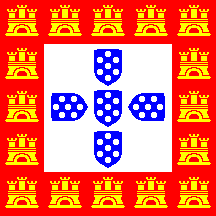
King Afonso III added a border red charged with castles gold marking
his marriage to Queen Beatriz, daughter of King Alfonso IX of Castille,
whose arms are a castle gold on red. “Popular” heraldry
attributes the castles to the definitive conquest and annexation of
Moorish Algarve, after seven battles, but the
Castille connection is much more probable, especially for the number of
castles was fixed to seven only in 1640.
António Martins, 21 May 1997
The seals of the time show that the designs of the castles were much
more crude than in this image, and changed with the time toward a better
graphic rendition. The same applies to the flag of
1385.
Mario Fabretto, 22 May 1997
The seals of the time showed especially a lack of standardization.
Those depicted in Livro das Horas de Dom Dinis, e.g.,
I’d certainly won’t call crude. Anyway, I chose to use the same castles
as in the modern flag, for that detail is heraldically irrelevant
(notice that often towers are used instead of
true castles — this is yes a heraldry error).
António Martins, 22 May 1997
Anything below this line was not added by the editor of this page.
Advertisement from our sponsor:
Bei Fahnenversand.de erhalten Sie eine Vielzahl an hochwertigen Flaggen, Pins und Aufnähern, zum Beispiel:


