This page is part of an mirror of © FOTW Flags Of The World website
This website is devoted to the science of vexillology (the study of flags).
All illustrations presented on this website serve exclusively to provide information in the context of vexillology.
The authors and hosts of this site explicitly distance themselfes from any symbols of unconstitutional organizations that may be depicted here.
Last modified: 2026-06-06 by martin karner
Keywords: georgian orthodox church |
Links: FOTW homepage |
search |
disclaimer and copyright |
write us |
mirrors
![[Flag]](../images/r/rel-orge.gif) image by Tomislav Todorovic
image by Tomislav Todorovic
See also:
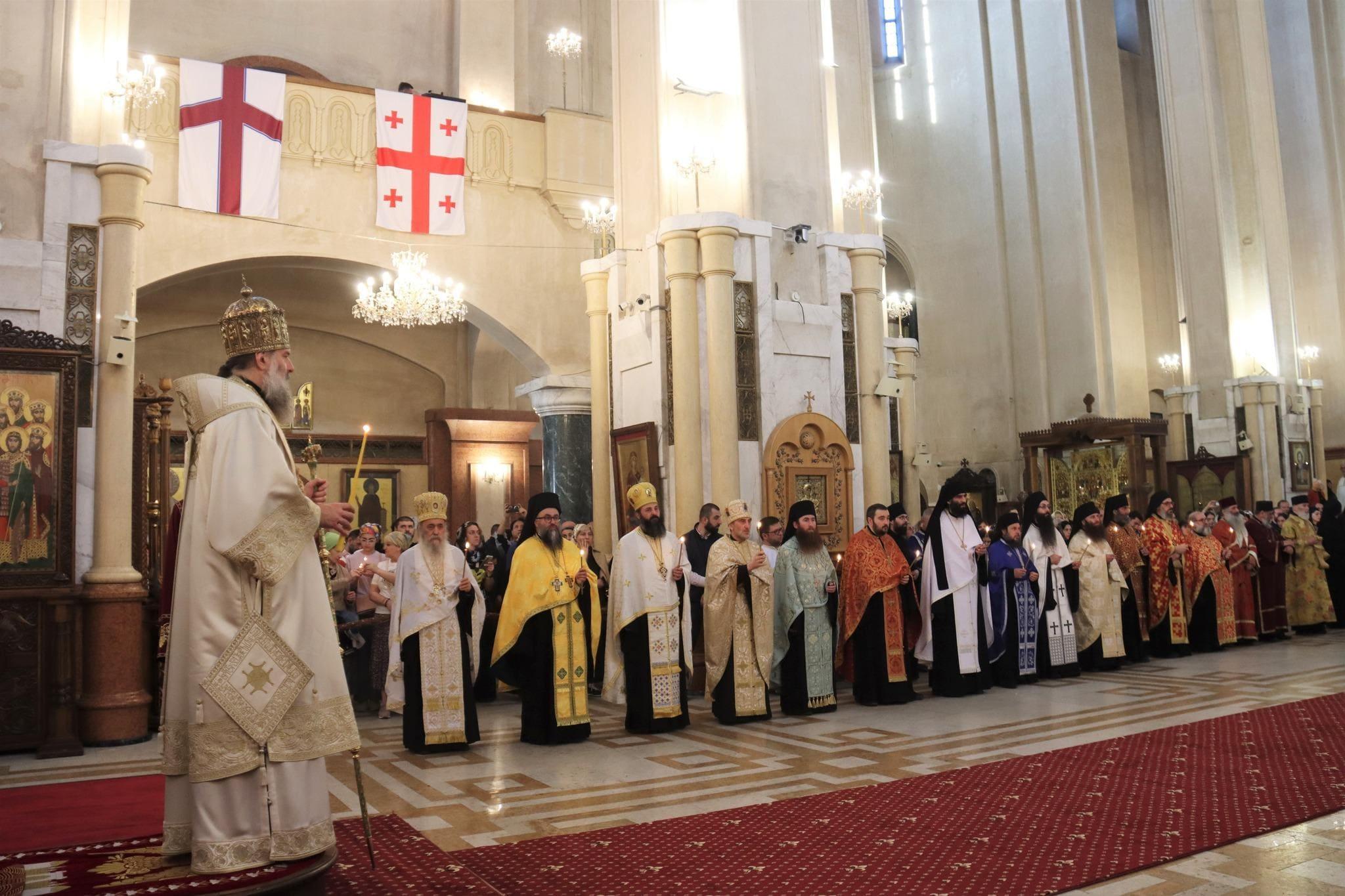
The flag of the Georgian Orthodox Church (photo [retrieved],
photo source,
photo [retrieved])
is white, in proportions 1:2, with a red St. Nino's cross fimbriated in white and blue. The shade of red
is darker than that of the national flag.
Tomislav Todorovic, 16 March 2013
St. Nino (c. 300 – c. 332) is nicknamed "The Enlightener of Georgia". One of the most
venerated saints of the Georgian Orthodox Church, Nino is said to have been a relative of St. George;
she converted different rulers so that King Mirian III (c. 284 – c. 361) of Iberia (today's Kartli)
adopted Christianity as the official religion c. 327.
The St. Nino's cross, also known as the
Grapevine cross, is the main symbol of the Georgian Orthodox Church.
The legend says that Nino received it from the Blessed Virgin (or made it herself with two grapevine
branches entwined with her own hair). During Persian and Turkish invasions, the holy cross was hidden in
Armenia, in the Georgian mountains, and, eventually in Moscow. Upon request of Prince George Bagration,
Tsar Alexander I returned the cross to Georgia in 1802. Since then, the cross has been preserved in the
Sioni Cathedral in Tbilisi.
Ivan Sache, 2 June 2012
.png)
(source)
Advertisement from our sponsor:
Bei Fahnenversand.de erhalten Sie eine Vielzahl an hochwertigen Flaggen, Pins und Aufnähern, zum Beispiel: