This page is part of an mirror of © FOTW Flags Of The World website
This website is devoted to the science of vexillology (the study of flags).
All illustrations presented on this website serve exclusively to provide information in the context of vexillology.
The authors and hosts of this site explicitly distance themselfes from any symbols of unconstitutional organizations that may be depicted here.
Last modified: 2017-11-11 by andrew weeks
Keywords: ommelanden | frisia | hearts |
Links: FOTW homepage |
search |
disclaimer and copyright |
write us |
mirrors
See also:
![[First historical flag of the Ommelanden]](../images/n/nl-omld1.gif) Mark Sensen, 29 June 1997 and 20 May 1998
Mark Sensen, 29 June 1997 and 20 May 1998
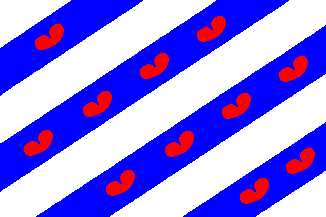
The flags of the Ommelanden (also known as Frisia between the [rivers] Eems and Lauwers, or Little Frisia) were banners of the arms: seven diagonal stripes white-blue with nine red hearts placed 1:3:3:2. At first (1474) these hearts were placed on the blue stripes. This was the arms of Magnus Ladulas of Sweden (1240-1290), but without the golden lion. It was believed these arms were the arms of the Frisian king Radboud (719), to which the Swedish king added the golden lion. (You can find the arms of Magnus Ladulas, although without the hearts, in the second and third quarters of the modern Swedish greater arms, and you can find the red hearts in the modern Danish arms).
![[Second historical flag of the Ommelanden]](../images/n/nl-omld2.gif) Mark Sensen, 29 June 1997
Mark Sensen, 29 June 1997
Around 1555 the hearts were placed on the white stripes, and after ca. 1582
there were eleven hearts placed 1:4:4:2. Those eleven hearts represented:
Vredewold, Langewold, Humsterland and Middachten (in the Wester Quarter),
Ubbigo, Inndersdijk, de Marne, het Halveampt and Oosterampt (in Hunzingo), het
Hoogland and Duirswolde (in Fivelgo).
This flag is very similar to the Frisian flag.
Mark Sensen, 12 January 1998
Advertisement from our sponsor:
Bei Fahnenversand.de erhalten Sie eine Vielzahl an hochwertigen Flaggen, Pins und Aufnähern, zum Beispiel: