
This page is part of an mirror of © FOTW Flags Of The World website
This website is devoted to the science of vexillology (the study of flags).
All illustrations presented on this website serve exclusively to provide information in the context of vexillology.
The authors and hosts of this site explicitly distance themselfes from any symbols of unconstitutional organizations that may be depicted here.
Last modified: 2023-06-03 by  zachary harden
Keywords: marijampole | sakiai |
Links: FOTW homepage |
search |
disclaimer and copyright |
write us |
mirrors
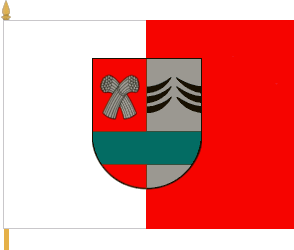
image by Virginijus Misiunas, 30 January 2010
See also:
Sakiai (Sakiai District) - on a divided per pale white and red
field the arms of Sakiai: divided per pale red and silver with a
lowered green fess, on the right side two crossed silver sheaves
of flax, on the left side 6 black fangs sticking 3 and 3 from the
edges of the silver field. The arms were designed in 1847, but
their meaning is not very clear. Green, white (silver) and red
are the traditional colours of Lithuania Minor, but Sakiai is not
a part of that region but of Suvalkija, even if related both
ethnically (the same dialect) and historically (in 1795-1807
Lithuania Minor and Suvalkija were one province of Prussia). The
sheaves of flax should represent the tradition of the linen
business. The fangs probably are not fangs but forks, and in this
case the arms are canting: "forks" is "sakes"
in Lithuanian. It would be a unique case where the arms of the
time of the Russian Empire are canting in Lithuanian, but on the
other hand they are the only Lithuanian arms of those times
designed by the citizens themselves (however not officially
granted: that happened only in 1970).
Virginijus Misiunas, 30 January 2010
Advertisement from our sponsor:
Bei Fahnenversand.de erhalten Sie eine Vielzahl an hochwertigen Flaggen, Pins und Aufnähern, zum Beispiel:


