
This page is part of an mirror of © FOTW Flags Of The World website
This website is devoted to the science of vexillology (the study of flags).
All illustrations presented on this website serve exclusively to provide information in the context of vexillology.
The authors and hosts of this site explicitly distance themselfes from any symbols of unconstitutional organizations that may be depicted here.
Last modified: 2020-07-31 by ian macdonald
Keywords: star (green) | crescent (green) | moon (green) | triband: diagonal (blue-white-black) | shabak |
Links: FOTW homepage |
search |
disclaimer and copyright |
write us |
mirrors
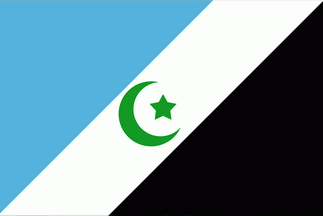
[The] Shabak is/are a people, a religion and a language, all belonging to northern
Iraq. More specifically, they live in the region of Mosul, and are
united in culture and language, but they cover more than one ethnic
group and among them there is more than one religion.
Their numbers are very hard to assess, being between 60,000 and
400,000 spread among 35 villages, of which Ali Rach, Yangija, Khazna
and Talara are the largest. LookLex uses the number 100,000 to assess
their number, but this is highly uncertain.
Throughout their history, the Shabaks have been considered a low class
in the Iraqi society, although there are few reports of persecution,
despite them being defined outside the Ahl al-Kitab, the people of the book.
Still, during recent decades, the Shabak have faced the hardship of
being dislocated, as an initiative of the central Iraqi authorities to
destroy their cultural identity.
A common theory, is that the Shabak are of Turkmen origins, and
migrants from Persia in the 17th century.
A large part of the Shabak are also related to the Kurds. Their name
is a reflection of their ethnic diversity, in Arabic 'shabak' means
"intertwine" and subgroups of the Shabak are known as Gergari,
Bajalan, Hariri and Mosul.
Their history in brief:
The flag above has a "fat" star, different than the "skinny" one
offered at Wikimedia Commons.
Chrystian Kretowicz, 19 Feb 2011
Advertisement from our sponsor:
Bei Fahnenversand.de erhalten Sie eine Vielzahl an hochwertigen Flaggen, Pins und Aufnähern, zum Beispiel:


