This page is part of an mirror of © FOTW Flags Of The World website
This website is devoted to the science of vexillology (the study of flags).
All illustrations presented on this website serve exclusively to provide information in the context of vexillology.
The authors and hosts of this site explicitly distance themselfes from any symbols of unconstitutional organizations that may be depicted here.
Last modified: 2026-02-28 by martin karner
Keywords: gersau |
Links: FOTW homepage |
search |
disclaimer and copyright |
write us |
mirrors
![[Flag of Gersau]](../images/c/ch-sz002.gif) image by Pascal Gross
image by Pascal Gross
Per pale Gules and Azure.
Christopher Southworth
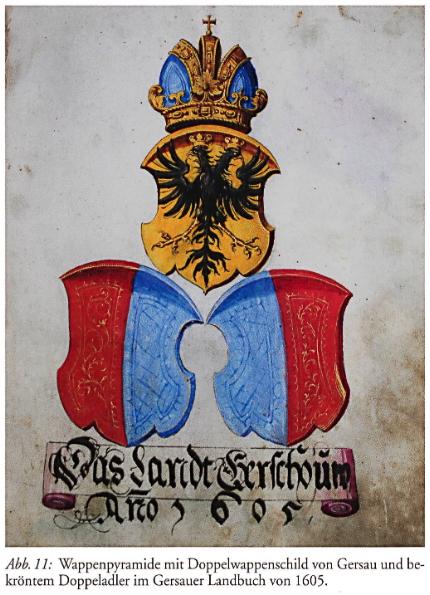
The oldest depiction¹ of the arms of Gersau is from 1605, in
the so-called Landbuch, a collection of legal texts.
In a source from 1711 the colours are depicted inversed; from 1742 on the colours have been
depicted always in the present order. There is no source nor story about the origins of the colours red and
blue.
Gersau joined the Swiss Confederation in 1359 as an independent entity and protectorate, and in 1433 it got
even imperial immediacy, becoming as a village the smallest republic of the world. After the Napoleonic era
in which Gersau lost its sovereignty, it achieved independence again for about 3 years, but then the Diet
of the Swiss Confederation decided to attach Gersau against its will to the Schwyz canton. The Republic of
Gersau was dissolved on 1 January 1818. Its area is identical with the Gersau district.
The fountain in front of the town hall has the inscription: GERSAU BLEIBT GERSAU, EIN FREIES VOLK |
EIN FREIES LAND (Gersau remains Gersau, a free people, a free land). (source,
source)
Martin Karner
¹ Mitteilungen des historischen Vereins des Kantons Schwyz, 110/2018
Advertisement:
Bei Fahnenversand.de erhalten Sie eine Vielzahl an hochwertigen Flaggen, Pins und Aufnähern, zum Beispiel: