
This page is part of an mirror of © FOTW Flags Of The World website
This website is devoted to the science of vexillology (the study of flags).
All illustrations presented on this website serve exclusively to provide information in the context of vexillology.
The authors and hosts of this site explicitly distance themselfes from any symbols of unconstitutional organizations that may be depicted here.
Last modified: 2021-12-24 by rob raeside
Keywords: metán department | salta province | argentina |
Links: FOTW homepage |
search |
disclaimer and copyright |
write us |
mirrors
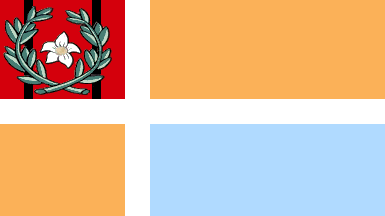 image by Jaume Ollé i Casals, 21 Feb 2012
The municipality of San José de Metán (locally known as Metán ; 27,453
inhabitants in 2001) is located in the south of the Salta Province.
The flag of San José de Metán, of recent origin, expresses the local
historical origins, traditions, idiosyncrasy and culture.
The flag is quartered by a white cross skewed to the hoist, the first
quarter crimson red with two vertical black stripes framing a lily
flower surrounded by two laurel branches, the second and third
quarters golden yellow, the fourth quarter celeste blue.
The lily flower represents the Catholic faith, as the flower raised in
his hands by St. Joseph, the patron saint of the town.
The two laurel branches, a symbol of victory, recall the historical
meeting of Colonel José de San Martín and General Manuel Belgrano in
Yatasto, a place located on the municipal territory of San José de
Metán. During the Argentine War of Independence, generals commanding
the Army of the North made handovers of command in Yatasto estate,
proclaimed a National Monument in 1942. On 26 May 1812, Juan Martín de
Pueyrredón gave there the command to Manuel Belgrano, who gave the
command to José de San Martín on 17 January 1814.
The crimson red color recalls the provincial flag of Salta and the
ponchos worn by the natives and the gauchos, including the national
hero Martín Miguel Güemes.
The two vertical black stripes recall the railway inaugurated in the
town on 13 June 1886; they also represent the tradition and character
of the region.
The golden yellow quarters symbolize honey, after which the word
"Metán" was coined by the Spaniards- from the Lule word "mep",
"honey". Golden yellow also represents the soil fertility and the
man's work, synthesized into wheat, maize and other grain spikes. The
colour also recalls the sun from the national flag and the stars from
the Salta flag.
The celeste blue quarter recalls the national flag and the sky
reflecting on the waters of the rivers.
The white cross uses a color from the national flag, meaning purity
and peace. The flag contest's jury added that the white vertical and
horizontal stripes form a Latin cross.
Ivan Sache, 5 Oct 2010
Advertisement from our sponsor:
Bei Fahnenversand.de erhalten Sie eine Vielzahl an hochwertigen Flaggen, Pins und Aufnähern, zum Beispiel:


