

Last modified: 2020-05-23 by rob raeside
Keywords: signal flags |
Links: FOTW homepage |
search |
disclaimer and copyright |
write us |
mirrors
See also:
In the Voyforum on "Naval History during the Age of Line Tactics (1650-1815)", there has since been a thread on this publication, http://www.voy.com/39735/6820.html. There it is pointed out that the original signal-book of the Admiralty first issued 13 May 1799 consisted of two volumes: "The new Admiralty Signal-Book for the Ships of War" covered daytime signals, and "Night Signals and Instructions for the Conduct of Ships of War" covered night-time signals. Apparently one of the volumes also contained a list numbering all the ships in the British Royal Navy. This one was printed for H.M. Stationery Office, which last century was in London.
The Signal-book for the Ships of War, 1799, on the other hand, was printed in
Madras by Henry Edles. It's a single volume with both daytime and night-time
signals, but does not include the ship list. Without being able to compare, it's
difficult to say how much of the content of the two publications matches. It
seems to have the same types of signals as the 1796 Signal-Book for the Ships Of
War, though.
Peter Hans van den Muijzenberg, 15 February 2010; 11
October 2013
The full title is: "Distinguishing Signals denoting particular Squadrons, Divisions, &c. of the Fleet, to which the general Signals, when made therewith, are meant solely to relate."
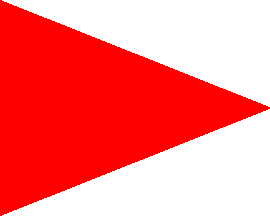
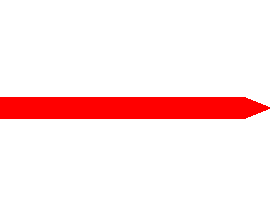
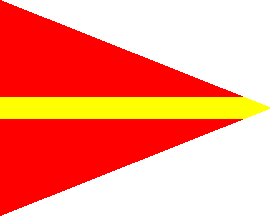
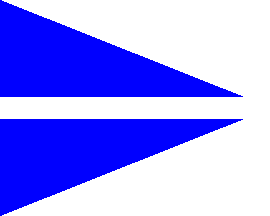
These are eight triangular flags indicating parts of the fleet by pattern and specific divisions of squadrons by accompanying pendant:
|
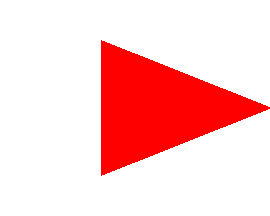
1 - Red, First or Centre Squadron |
|
2 - White with red stripe, Second or Van Squadron |
|
3 - Blue, Third of Rear Squadron |
|
4 - Red with yellow stripe, Starboard Division |
|
5 - Blue with white stripe, Larboard Division |
|
6 - Red with white hoist, Whole fleet but by each division separately |
|
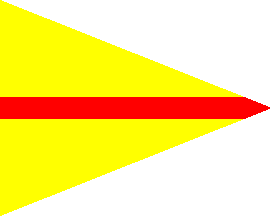
7 - Yellow with red stripe, Division without Commander |
|
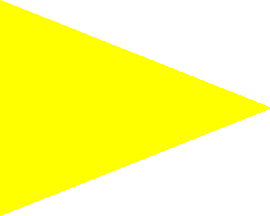
8 - Yellow, Transports or Ships under Convoy |
The book shows a number of signals with single
flags
[All images by Peter Hans van den Muijzenberg, 15 February 2010;
larger images available by clicking on displayed images.]
Numeral flags:
 |
1 - Enemy in sight. | Red |
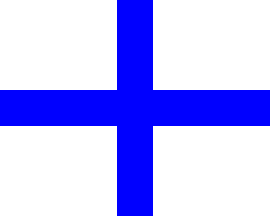 |
2 - Sailing by Divisions. | White with blue cross |
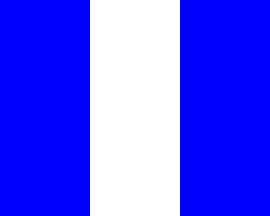 |
3 - Order of Sailing. | Blue with white pale |
 |
4 - Station, to keep it in Battle or Sailing. | Yellow with black borders along the flywise edges |
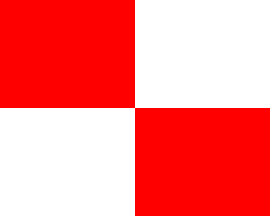 |
5 - Engage. | Quartered red and white |
 |
6 - Signal not distinct. | Per rising diagonal white over blue |
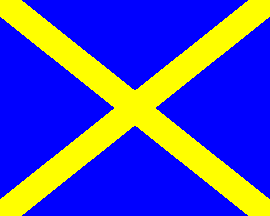 |
7 - Chase. | Blue with yellow saltire |
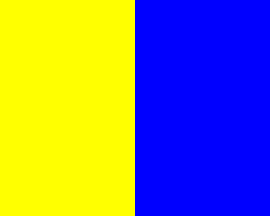 |
8 - Anchor. | Per pale yellow and blue |
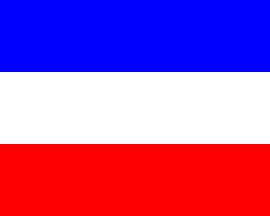 |
9 - Recall from Chase. | Blue over white over red |
 |
10 - Truce. | White |
 |
11 - Answer, different. | Blue pierced white. |
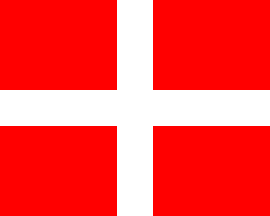 |
12. Affirms. | Red with white cross |
 |
13 - Annuls. | White with a red border |
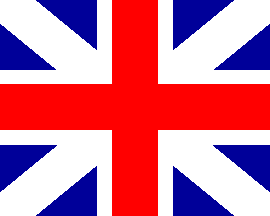 |
14. Officers wanted. | Union Jack (of two kingdoms). |
 |
15 - Signals to take effect after close of day. | White over black. |
 |
16 - Secret Instruction | Black over white (presumably 15 upside down). |
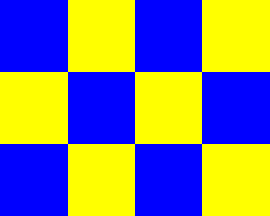 |
17 - Rendez-vous. | Chequered of twelve, blue and yellow |
 |
18 - Fire Ships. | Yellow |
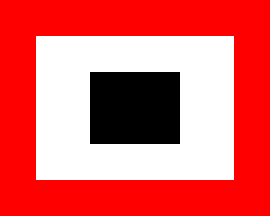 |
19 - Change of Numeral Signals. | White bordered red, pierced black |
 |
23 - Compass Signal, N. E. | White over red |
|
24 - Compass Signal, N. W. | Red over white (presumably 23 upside down). |
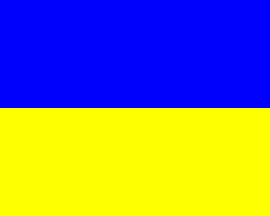 |
25 - Compass Signal, S. E. | Blue over yellow |
 |
26 - Compass Signal, S. W. | Yellow over blue (presumably 25 upside down). |
 |
27 - Cornet. | Blue cornet |
 |
28 - Preparative. | Five stripes blue over white |
Then the numeral flags are described in a separate
section: 1-9 are the same, but Blue pierced white is 0, while White is
substitute Flag. This difference must be what makes uncertain which flags
were the 0 and substitute in the first Popham code.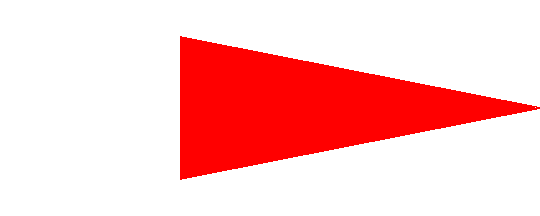

The pennant white with red fly denotes 100. While the meaning for that pennant is printed, in the space left open below it a pennant white with a blue hoist has been drawn, as all the flags have been drawn, with the written meaning "200". It's not mentioned in the text, but apparently it serves to denote 200. (The highest number used is signal 205.)
Then follow the predefined messages, with the numbers 15 to 200 written in, then four empty rows and finally 205. The need for a 200 pennant, thus arose from starting at 15. I wonder what made that necessary.
For
pendant signals, with significance depending on the hoist location, a
number of pennants is being used:
 |
Red Pendant | Red |
 |
Blue Pendant | Blue |
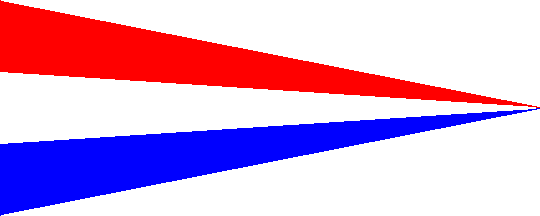 |
Striped Red White and Blue | Tapering stripes of red over white over blue. This is probably also the pennant that elsewhere is indicated as Dutch. |
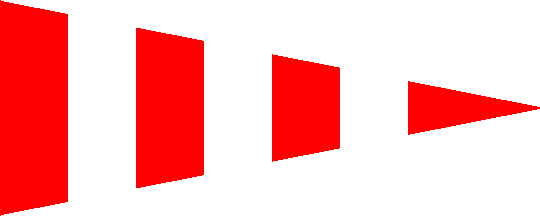 |
Alternate Red and White | Horizontally alternating red and white, the fourth red longer and colouring the tip. [This is probably also the pennant that elsewhere is indicated as Striped Red & White.] |
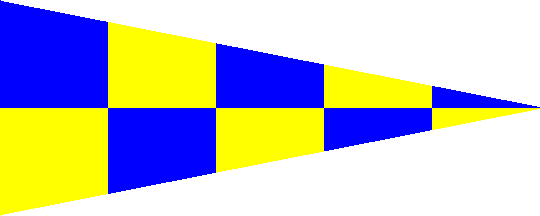 |
Chequered Blue and Yellow | Chequered of ten blue and yellow |
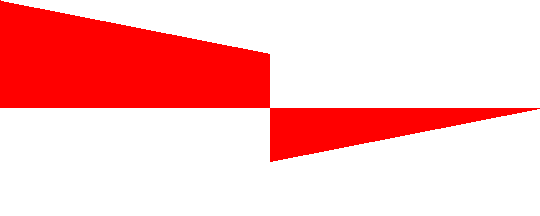 |
Quartered Red and White | Quartered red and white |
 |
White Pendant | White |
For this the Union, presumably Supplemental Flag 14, is hoisted in various
positions, with different signal pendants flying over it.
Supplemental Flag 18, no doubt, flown in different positions, mostly to indicate
fire ship-specific messages.
Signals by private ships by day are also flag signals. These, the tabular signals, are given as numbers of a table starting, horizontally, with the numbers
|
1. Red. |
 |
2. Blue |
|
3. White over red |
|
4. Red over white |
|
5. Blue over yellow |
|
6. Yellow over blue |
|
|
7. Union Jack |
|
8. blue over white over red |
Then the same list is repeated vertically to indicate the second
flag in a two flag hoist, resulting in:
9 red, red
10 blue, red
etc.
Substitute white
Annul yellow
This would allow for 72
numbers, if it weren't for the fact that the combinations of 3 and 4 have to be
skipped, for them being the same flag, and likewise for 5 and 6, resulting in 68
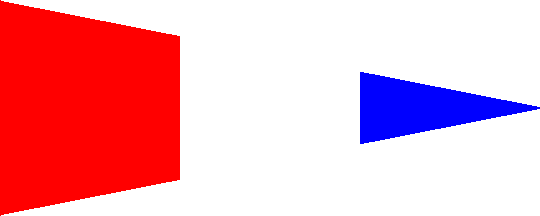
numbers. Drawn at the bottom of the page, however, is an additional pennant,
with written above it "70. Pendant". As this is a pennant, it's probably meant
to be similar to the 100 pennant, in this case adding 70 to the number - red
before white before blue.
 Also sailed on the midnight tide, it seems.
There are two small differences, however. It's impossible to signal 69, and since there's no zero flag, to signal 70 the pendant has to be flown alone.
The signals go up to 80, and since these instructions are all printed, the lack of a method to signal above 68 must have been an omission. The added 70 pendant apparently was a correction of this, rather than being, like the 200 pennant, an extension.
A few signals are given in a different way, e.g.:
MAN - That one has fallen overboard. To be denoted by a common Pendant at
Ensign staff.
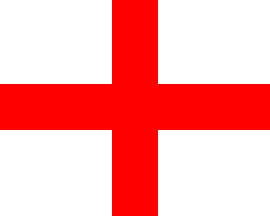
"Where Pilot Vessels are necessary to be placed for directing Navigation
of the Fleet by day, those wearing an English Jack or Ensign at the Mast-head
are to be left to Starboard, and those wearing a White Jack or Flag at the same
place are to be left to Port."
An English jack
would have quite a lot of white in it. According to this, the pilot would always
show a white flag, with the direction depending on whether the white flag bore a
cross or not. An "English ensign," I'm not sure how to read. Is this merely a
different size, or is it a coloured flag with an English canton?
Peter Hans van den Muijzenberg, 11 October 2013
It is unlikely to have been a coloured flag with an English canton since that would have meant carrying a flag that would have had no use except for making this particular signal.
I checked the 1796 version, and it says:
Mem.
ALL Vessels laid upon
Shoals in order to point out the Channel, will be distinguished by a Red Flag,
and a White Flag at their Mast Heads. Those with the Red Flag are always to be
passed, leaving them on the Starboard Hand, and those with the White Flag to be
passed, leaving them on the Larboard Hand.
Where the earlier
instructions have a red flag, the later edition has an "English Jack or Ensign"
in a similar situation. But it occur to me that you'd be sailing between war and
peace, that way. White - Truce - might not have been considered a big problem,
but Red - Enemy in Sight - probably was a signal only to be signalled when true.
(Between 1796 and 1799, "Larboard" apparently became "Port" for the
admiralty.)
David Prothero, 13 October 2013
North-west |
North-east |
| South-west |
South-east |
The compass directions are indicated with a Red & White flag for North East, Blue and Yellow for South East, Yellow and Blue for South West, and White & Red for North West. Each of these can be modified with pennants to indicate 8 points each: Starting with the counter clockwise cardinal point: Red pendant over the flag, White, Blue, and Dutch, then comes the ordinal point with just the flag, and then Red pendant under the flag, White, and Blue.
(Copied inconsistencies from the original as well I
could.)
Peter Hans van den Muijzenberg, 15 February 2010; 11
October 2013
The 1799 book exposes a long standing error about the flag that represented
numeral 'one'.
Hulme (1894), Gordon (1915), Perrin (1922), Wheeler-Holohan
(1939) and Holland (1930s) all wrote that the flag representing numeral 'one' in
the 1799 Signal Book was 'yellow over red over yellow'. In the copy of that book
in the University of Rhode Island collections it is 'red'. It could have been
that the flag was incorrectly coloured, in that particular copy, when the
coloured flags were added by hand to the black and white print, but fortunately
there is a reference to the flag in the Remarks next to the flags; "If he would
express the No. 31, this Flag No. 3 will be hoisted over a Red Flag No. 1,
making together the number 31". This means that the numeral flags in the 1799
book were the same, with the same meaning, as the flags in Lord Howe's numerary
system of 1790. The 'yellow over red over yellow flag' replaced the 'red flag'
before 1803, as the latter did not feature in the revised code of that year. A
possible reason for the change was that the command flag of the red squadron
could be confused with it, when it was flown as a 'single flag' signal. A note
after the signification of the 'red flag' reads, "The flag will be shewn with a
common Pendant over, by Flag-Officers of the Red Squadron having occasion to
make this signal."
David Prothero, 17 February 2010
Anything below the following line isnt part of the Flags of the World Website and was added by the hoster of this mirror.


