 klaus-michael schneider
Keywords: education |
Links: FOTW homepage | search | disclaimer and copyright | write us | mirrors

Last modified: 2021-05-21 by klaus-michael schneider
Keywords: education |
Links: FOTW homepage |
search |
disclaimer and copyright |
write us |
mirrors
![[Flag of Colombia]](../images/c/co.gif) (2:3)
(2:3)  image by Željko Heimer, 20 May 2001
See also:
Other Institutions:
 image by Ivan Sache, 1 January 2021
Gimnasio Sabio Caldas was established in 2000 in Bogotá.
The school's
name ("Wise Caldas") refers to the naturalist and politician Francisco José de
Caldas (1768-1816), who supported the independence and was executed by the
Spanish troops.
The flag of Gimnasio Sabio Caldas is horizontally divided
blue-green (4:1) with the white emblem of the school in the center.
Blue
represents the sky, and the youth's ideas and illusions.
Green represents the
natural environment, enthusiasm, calm and peace.
The emblem represents a
lively, running student.
https://sabiocaldas.edu.co/el-sabio/nuestros-simbolos/bandera
School
website
Ivan Sache, 1 January 2021
 image by Ivan Sache, 1 January 2021
The flag is also used without the emblem.
Photo
https://i0.wp.com/sabiocaldas.edu.co/wp-content/uploads/2016/05/IMG_0535.jpg?w=1500&;ssl=1
Ivan Sache, 1 January 2021
 image by Ivan Sache, 05 January 2009
"Colegio del Sacrado Corazón" (of the Sacred Heart)
was founded in Baranquilla in 1956. The different sections of the
institute were progressively recognized by the Ministry of
National Education. All the relevant Decrees were superseded on
25 November 1978 by Decree No. 17518 recognizing all the sections
of the institute
The flag of the institute, according to photos
and the description
available on the website of the institute, is horizontally
divided red-white-red.
Red represents the love burning in the sacred heart of Jesus.
White represents the purity of the Christian doctrine.
Ivan Sache, 5 January 2009
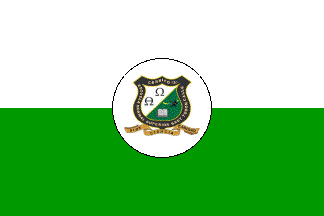 image by Ivan Sache, 31 October 2014
Escuela Normal Sady Tobón Calle was established in El Cerrito (Valle
Department) by the parish priest, Sady Tobón Calle. Classes started on 8
February 1960 in a house owned by Cristóbal Duarte. On 20 April 1960, the parish
priests of San Miguel, Miranda, Carcasí, and Capitanejo asked the Bishop to
close the school, arguing that Father Tobón had initiated it only for his own
enrichment and that education given there was impious and against the Christian
religion, aiming at increasing the number of Liberals in the area. The Bishop
visited the school during the next two days and deemed the accusations against
Tobón null and voided.
Jairo Pimiento Traslaviña, appointed director of the institute in 1992, was
murdered in a terrorist attempt on 2 December 1993. The institute was renamed
Escuela Normal Superior Sady Tobón Calle by Resolution No. 9,026 of 12 October
2001; Father Sady Tobón Calle died on 17 January 2004 in Medellín.
The flag of the institute, adopted in 1962, is horizontally divided white-green
with the institute's emblem, placed on a white disk, in the middle. White is a
symbol of joy and aspiration to peace. Green is a symbol of hope.
The emblem of the institute is an heart-shaped shield, with the same colours as
the flag, but arranged transversally. The upper part is white, a symbol of
transparency, peace, and verity, and charged with the Greek letter "Α" and "Ω",
which represent the presence of God, the beginning and end of everything, in all
our acts. The lower part is green, charged with a human figure in a dynamic
attitude, wrapped inside the Colombian tricolor and bearing an Olympic torch,
and with an open book, as a symbol of science and pedagogic knowledge.
The shield has a black bordure charged with the name of the institute and the
name of the municipality (at the top) in golden yellow letters. Beneath the
shield is a scroll or inscribed with the motto "DIOS CIENCIA CARIDAD" (God
Science Charity) inscribed in black letters. The original design of the shield
was modified in 2001, following the initiative of Jaime Hugo Pulido, director of
the school.
Source:
http://ensadytobon.wordpress.com/about/ - Institute's website
Ivan Sache, 31 October 2014
 image by Ivan Sache, 03 November 2014
Centro Educativo Sagrada Familia de Nazaret (CESFN) was established in Bogotá
by the Missionary Daughters of the Holy Family of Nazareth, a congregation
founded in 1874 by St. Josep Manyanet Vives (1833-1901; canonised on 16 May 2004
by Pope John Paul II)
The flag of the institute is dark blue with the institute's emblem in the
middle. Dark blue is the colour of the student's uniform in all educational
institutes established by the Missionary Daughters of Nazareth. The emblem of
the institute features:
- a snow-topped mountain representing Mount Teide, the highest mountain in
Spain, meaning that you always have to go up to the top to reach excellence;
- a torch, as a symbol of triumph and accomplishment:
- the name of Nazaret written in the heavens.
Source:
http://www.colegionazaret.edu.co/2014/index.php/nuestro-colegio/emblemas -
Institute's website
Ivan Sache, 03 November 2014
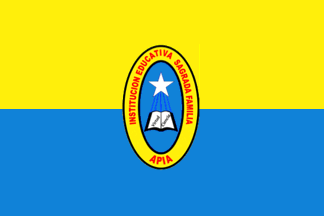 image by Ivan Sache, 3 January 2021
Institución Educativa Sagrada Familia is located in Apía (Risaralda).
The flag of IE Sagrada Famimlia is horizontally divided yellow-blue with the
school's emblem in the center.
Photo
https://www.facebook.com/Institución-Educativa-Sagrada-Familia
Yellow
represents intellectual, moral, social and religious resources
Blue
represents limpidity and brightness, virtue, purity and symphony, rectitude and
constancy, peace, calm and serenity.
The star is a symbol of knowledge
and intellectual resources.
The open book is a symbol of mind, life, proper
personality; each page of the book or of the student's life shall be sealed with
the motto "Virtue and Science". The ray emitted y the star illuminate the book,
permanently open.
https://www.sagradafamiliaapia.edu.co/trans_contratos.html
School
website
Ivan Sache, 3 January 2021
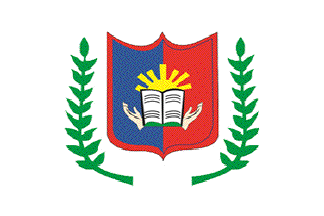 image by Ivan Sache, 25 July 2014
Colegia Sagrada Sabiduria (Sacred Knowledge) is located in Soledad (Atlántico
Department).
The flag of the institute is white with the institute's
emblem in the middle.
The emblem of the institute is a shield vertically
divided blue-red and bordered in red. In the middle is placed a white, open book
surmounted by a yellow rising sun and flanked by two white hands. The shield is
surrounded by two green wreaths.
http://colegiosagradasabiduria.edu.co/?page_id=20 - Institute's website
Ivan Sache,
25 July 2014
 image by Ivan Sache, 30 October 2014
Escuela Sagrado Corazón was established on 4 February 1920 in Chita (Boyacà
Department) by Emilio Larquere. He was succeeded in 1923 by José María Potier,
who changed the name of the school to Liceo Sagrado Corazón para Señoritas. The
school was renamed Escuela Normal Sagrado Corazón in 1956. Closed in 1960, the
institute was re-opened in 1962, as Colegio Sagrado Corazón, renamed Escuela
Normal Nacional Mixta Sagrado Corazón in 1980.
The flag of the institute is horizontally divided white-green. White is a symbol
of peace. Green is a symbol of aspiration to a better future.
Source:
http://escuelanormalsuperiorchita.jimdo.com/simbolos/bandera/ - Institute's
website
Ivan Sache, 30 October 2014
 image by Ivan Sache, 9 January 2004
The flag of the College is white with two red triangles in the
upper left and lower right corners. Red represents the Sacred
Heart of Jesus.
Source: <www.voluntad.com.co>,
located by Dov Gutterman.
Ivan Sache, 9 January 2004
 image by Ivan Sache, 8 November 2010
Colegio Sagrado Corazón de Jesús de La Salle, located in San José de Cúcuta,
Department of Norte de Santander, was founded on 3 June 1903 by Father Pablo
Alegria. The institute is managed by the Brothers of the Christian Schools,
founded by St. Jean-Baptiste de La Salle.
The flag of Colegio Sagrado Corazón de Jesús de La Salle, as shown graphically
on the institute's website, is horizontally divided yellow-olive green. Yellow
represents light and wisdom. Olive green represents hope. The same colors are
used on the institute's coat of arms.
Ivan Sache, 8 November 2010
 image by Ivan Sache,
6 July 2014
image by Ivan Sache,
6 July 2014
Colegio Sagrados Corazons was established in 1950 in Florencia (Caqueta
Department) by the Congregation of the Daughters of the Holy Hearts of Jesus and
Mary, founded in 1868 by the Italian nun Eugenia Ravasco (1845-1900; beatified
on 27 April 2003 by Pope John Paul II).
The flag of the institute is
horizontally divided celestial blue-pink. Blue and pink are the colours of the
cloak and of the tunica of Mary Help of Christians.
http://www.sagradoscorazones.edu.co/site/simbolos/gestion-directiva/simbolos.html
- Institute's website
Ivan Sache, 6 July 2014
 image by Ivan Sache, 22 September 2014
Colegio San Pascual Baylon, located in the parish of América, part of the
town of Medellín (Antioquia Department) was closed in 1944 by its founder and
director, Alfonsos Lopera Lopera. In December 1944, several "important and
influent" inhabitants convinced the recently appointed (6 October 1944) parish
priest, José Betancur Campuzano, to push the establishment of a parish school.
His Grace Joaquín García Benítez (1883-1958), Archbishop of Medellín (1942-1957)
allowed in 1945 the priest to establish Liceo Salazar y Herrera. The new school
was named for His Grace Tiberio de Jesús Salazar y Herrera (1871-1942),
Archbishop of Medellín (1937-1942), known as the "Education's Archbishop",
founder of Escuela Normal Antioqueña para Señoritas and of the Universidad
Pontificia Bolivariana.
Source:
http://www.salazaryherrera.edu.co/ - Institute's website
The flag of the institute, adopted in 1964, is horizontally divided
blue-white-red. Blue is a symbol of value, audacity, and intrepidness. White is
a symbol of purity. Red is a symbol of nobleness, majesty, and serenity.
Source:
http://www.salazaryherrera.edu.co/es/Liceo/Institucional/Simbolos -
Institute's website
Ivan Sache, 22 September 2014
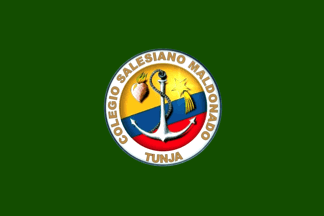 image by Ivan Sache, 13 May 2021
Colegio Salesiano Maldonado is located in Tunja (Boyacá).
The flag of Colegio Salesiano Maldonado is dark green, a symbol of hope
and friendship, charged in the center with the school's coat of arms.
The coat of arms, designed by teacher Boidi, emphasizes the Salesian
ideal. The radiating star, the big anchor and the burning heart
represent the theological virtues: Faith, Hope and Charity.
school website
Ivan Sache, 13 May 2021
image by Ivan Sache, 26 July 2018
Colegio Salesiano San Juan Bosco is located in Dosquebradas (Risaralda
Department).
The flag of Colegio Salesiano San Juan Bosco is horizontally
divided green-white.
Green is a symbol of joy and optimism.
White is a
symbol of excellence.
http://www.salesianosjb.edu.co/web2/index.php/instiutcional/menu-options/manual-de-convivencia
Manual de Convivencia
Ivan Sache, 26 July 2018
 image by Ivan Sache, 24 September 2014
Liceo Samper Uribe was established in 1967 in Sibaté (Cundinamarca
Department) by Gustavo Quijano Velandia, as Gimnasio Frances Honorato de Balzac.
The institute was renamed Liceo Samper Uribe the next year, as a tribute to the
contribution of the Samper and Uribe families to the socio-economic development
and establishment of the municipality of Sibaté.
The flag of the institute is horizontally divided emerald green-white-yellow,
with a red triangle placed along the hoist. The triangle is a symbol of harmony
and perfection. Green is a symbol of hope. White is a symbol of purity. Yellow is
a symbol of splendour and joy. Red is a symbol of life, youth, and vigour.
Source:
http://www.liceosamperuribe.com/joomla/index.php/colegio/simbolos -
Institute's website
Photos:
http://www.liceosamperuribe.com/joomla/index.php/galeria/image?view=image&format=raw&type=orig&id=109
http://www.liceosamperuribe.com/joomla/index.php/galeria/image?view=image&format=raw&type=orig&id=110
http://www.liceosamperuribe.com/joomla/index.php/galeria/image?view=image&format=raw&type=orig&id=64
Ivan Sache, 24 September 2014
 image by Ivan Sache, 24 September 2018
Colegio San Agustín was established in 1956 in San Agustín borough,
Facatativa (Cundinamarca Department), by Carlos Julio Cárdenas Villamizar,
Ismael Carvajal and Alejandro de la Torre. In 1980, the school was taken over by
Martínez Ltda., a company founded by Raúl Heráclito Martínez Sánchez, Myriam
Gladis Martínez, Adiela de González, Carmen Fabiola Martínez de Yomayusa, Amanda
Martínez, Carlota Martínez de López and Gloria Elsy Martínez.
http://www.colegiosanagustinfacatativa.edu.co/
School website
The
flag of Colegio San Agustín is divided blue-green by an ascending diagonal white
stripe.
Green, the image of the natural environment, represents aspiration to
growth, youth, friendship, community service and ecological awareness.
White,
a symbol of purity, represents transparency, mind clarity, perceptiveness, truth
and rectitude.
Blue represents intelligence, joy, adolescence, felicity,
loyalty, honor and spiritual maturity.
http://www.colegiosanagustinfacatativa.edu.co/simbolos.html#bandera
School website
Ivan Sache, 24 September 2018
 image by Ivan Sache, 25 September 2014
Escuela San Agustín was established on 8 October 1888 in Popayán (Cauca
Department) by Sister Antoinette Lafay, member of the Sisters of Charity of
Saint Vincent de Paul, a congregation founded in 1633 by St. Vincent de Paul
(1581-1660; canonized on 16 June 1737 by Pope Clement XII) and St. Louise de
Marillac (1561-1660; canonized on 11 March 1934 by Pope Pius XI). Concentración
Escolar San Agustín was established in 1955. Lacking staff, the Sisters of
Charity had to abandon the management of the institute in 1998. His Grace Iván
Antonio Marín, Archbishop of Popayán, commissioned the Sisters of the Charity of
St. Ann, a congregation founded by María Rafols (1781-1853) and Juan Bonal
(1769-1829), to take over the institute.
The flag of the institute is horizontally divided white-green. White is a symbol
of faith and purity. Green is a symbol of honour, friendship, and courtesy.
Source:
http://sanagustinpopayan.edu.co/index.php/component/content/category/9-institucion
- Institute's website
Ivan Sache, 25 September 2014
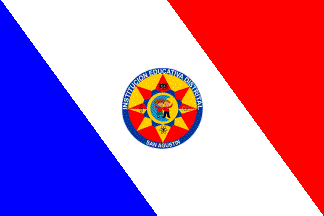 image by Ivan Sache, 30 October 2011
"Institucion Educativa Distrital San Agustin" was founded in 1970 in Bogotá.
The flag of the institute is diagonally divided blue-white-red with the
institution's emblem in the middle.
Blue symbolizes intelligence, truth and knowledge. White symbolizes aspiration
to peace and social development. Red symbolizes passion, love, action and
triumph.
The emblem was selected in a contest opened to students and professors in art.
The emblem is horizontally divided yellow-red with an eight-pointed star all
over; the rays of the star are counter-colored. The ray pointing to the north is
charged with an open black book charged with the white letters "SA" (for "San
Agustin"), while the ray pointing to the south is charged with the black symbol
of atomic physics (a black nucleus surrounded by three black ellipses
representing electron's orbits). The ray pointing to the west is charged with a
black G-clef, while the ray pointing to the east is charged with the Olympic
rings.
In the middle of the sun is a yellow disk, separated from the rays by blue
pentagons. The disk is charged with a light blue crescent and a girl and a boy
wearing the uniform of the institute. The emblem is surrounded by a blue ring
charged with the name of the institute, written in white capital letters.
Source:
http://fr.calameo.com/read/0004137826eea57ba4c75
Ivan Sache, 30 October 2011
 image by Ivan Sache, 26 June 2014
Colegio San Alberto Magno (COLSAM) was established on 5 December 1974 by the
Order of Preachers (Dominicans) in the San Luis borough of Barranquilla
(Atlántico Department).
The college is named for St. Albertus Magnus (1206-1280; canonized on 16
December 1931 by Pope Pius XI), a German Dominican friar considered as the
greatest German philosopher and theologian of the time.
The flag of the institute, as seen on several photos available on the
institute's website, is horizontally divided yellow-red-white with a triangle
horizontally divided black-white placed along the hoist.
http://www.colsam.edu.co/web/images/phocagallery/2012/210entregasimbolos/thumbs/phoca_thumb_l_img_0438.jpg
http://www.colsam.edu.co/web/images/phocagallery/2013/30anos200/thumbs/phoca_thumb_l_dsc_0036.jpg
 image by Ivan Sache, 26 June 2014
Another flag is shown graphically and described in great detail on the
institute's website. This flag is horizontally divided black-red-yellow with a
half-star faceted white and black placed along the hoist. The flag is based on
the national flag of Germany, the country of St. Albert the Great. The black and
white star recalls the coat of arms of the Order of Preachers, founder and
manager of the institute.
Black and white are the colours of the cloak of the Friars Preachers; black,
absorbing light and colours, is a symbol of contemplation, while white,
projecting and reflecting them, is a symbol of predication. White and black are
the expression of the fraternal kiss of the Colombian Caribbean race, which
struggles for peace and the eradication of all kind of racial, political and
religious discrimination. Red is a traditional symbol of love and sacrifice,
which initiate evangelical compassion in the institute's college. Yellow is a
symbol of the Gospel's light that enlightens the man's life. Yellow and red
recall the sandy ravines of the town, which was awarded the title of Colombia's
Golden Gate.
Source:
http://www.colsam.edu.co/web/index.php?option=com_content&view=article&id=51&Itemid=92
- Institute's website
Ivan Sache, 26 June 2014
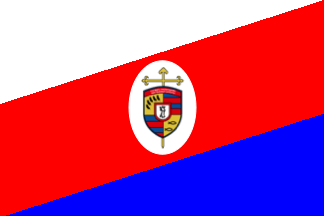 image by Ivan Sache, 3 January 2021
Colegio Parroquial San Andrés Apóstol bwas established in Fontibón Centro,
Bogotá, by the Fundación Educativa Santiago Apostol.
The flag of Colegio
Parroquial San Andrés Apóstol is divided white-red-blue from the lower hoist to
the upper fly, charged in the center with the school's coat of arms inscribed in
a white oval.
White represents light, knowledge and wisdom.
Red represents
sacrifice, force and commitment to great causes.
Blue represents liberty and
presence of love via Jesus.
In the center of the coat of arms is placed a
white escutcheon portraying Apostle St. Andrew bearing his cross.
In the
first and third quarter, the five breads and the two fish, respectively
symbolizes St. Andrew as the master of solidarity*.
In the second and third
quarters, the red and blue stripes recall the school's colors. Red symbolizes
St. Andrew's martyr. Blue symbolizes glory achieved for having offered his life
for Jesus' love.
Gold symbolizes sanctity.
The Cross of Saint James
symbolizes union with the Fontibón diocese.
https://fesa.edu.co/colegio-parroquial-san-andres-apostol
School website
*John 6:8-9 : "Another of his disciples, Andrew, Simon Peter’s brother,
spoke up, “Here is a boy with five small barley loaves and two small fish, but
how far will they go among so many?"
Ivan Sache, 3 January 2021
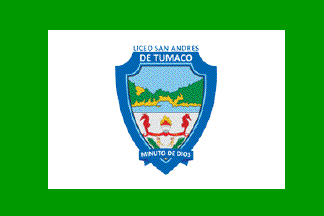 image by Ivan Sache, 12 March 2017
Liceo San Andrés de Tumaco was established in 2014 in Tumaco, Nariño
Department, by Corporación Educativa Minuto de Dios, a corporation founded in
1958 by Father Rafael García Herreros Unda (1909-1992), which manages 24
educational institutes all over Colombia.
http://www.colegiosminutodedios.co/tumaco/index.php/ - Institute's website
The flag of the institute is white with a green border and the institute's
emblem in the center. The emblem of the institute is made of the municipal
emblem of Tumaco, with added writing, "LICEO SAN ANDRÉS / DE TUMACO" (top) and
"MINUTO DE DIOS" (bottom).
http://www.colegiosminutodedios.co/tumaco/index.php/quienes-somos/nosotros/simbolos
- Institute's website
Ivan Sache, 12 March 2017
 image by Ivan Sache, 14 June 2018
Institución Educativa San Antonio de Padro (SADEP) was established by
Departmental Resolution No. 16,348,adopted on 27 November 2002, as the merger of
Escuela Carlos Betancur Betancur, Escuela Manuel María Mallarino, Liceo San
Antonio de Prado, and Sede Rural Potrerito.
Source: SADEP website
The flag of SADEP is horizontally divided green-white-yellow. Green represents
aspiration to a better future in a democratic, fair and peaceful country;
respect for nature and environment. White means peace. Yellow represents the sun
as a source of life and abundance.
Source:
SADEP website
Ivan Sache, 14 June 2018
 image by Ivan Sache, 28 March 2009
"Institución Educativa 'San Antonio de Padua' "
(IESAP) was founded in 1906 by Próspero Restrepo at Támesis,
Department of Antioquia. Originally named "Colegio de San
Antonio", the institute was successively renamed "Liceo
Alejandro Próspero Reverend" (1952), "Liceo Regional
Alejandro Próspero Reverend" (1961) and "Liceo
Regional Rafael J. Méjía" (Decree No. 1415, 28 September
1966). IESAP was officially founded on 7 February 2003 (Decree
No. 865) as the merger of "Liceo Regional Rafael J.
Méjía", "Escuela Eladia Mejía González" and
"Preescolar Mis Amiguitos".
The flag of IESAP, as shown graphically on the website
of the institute, is horizontally divided green-blue-red with
awhite triangle placed along the hoist.
It was presented, together with the emblem of the institute,
during the celebration of the 100th anniversary of the institute,
held on 14 August 2006.
Ivan Sache, 28 March 2009
 image by Ivan Sache, 26 June 2014
Colegio San Antonio María Claret was established on 12 October 1959 in Cali
(Valle del Cauca Department) by the Congregation of Missionaries Sons of the
Immaculate Heart of Mary (Claretians).
The Claretians, a congregation founded on 16 July 1849 by the Catalan priest
Anthony Mary Claret (1807-1870; canonized on 7 May 1950 by Pope Pius XII),
settled in Cali in 1951.
The flag of the institute is garnet red with a yellow triangle placed along the
hoist and reaching the mid-fly. Garnet red is a symbol of strength, commitment,
passion, desire and love.
Yellow is a symbol of the sunlight, joy, felicity, cleverness and energy.
Source:
http://www.colegioclaret.edu.co/simbolos.html
Ivan Sache, 26 June 2014


